CBS Well-being Lab initiated this project to investigate if and how international student well-being is an issue CBS, and how it might be addressed. This is a fairly well-documented but less well researched problem, and in conversation with students we became aware that international students might face unique challenges that deserve more in-depth attention. This prompted our curiosity and led us to conduct an interview study of 16 bachelor’s and master’s students at CBS, including both EU and non-EU backgrounds.
The resulting report, Understanding International Student Well-being at Copenhagen Business School (Gürsoy & Pedersen 2026), explores how students experience well-being while studying in a new country, what supports them and what makes student life more difficult. It confirms that there it is an issue at CBS but also provides more surprising insights on how much of the issue revolves around the more intricate dynamics of fitting into a social study environment. The report identified three broad areas where CBS could consider strengthening its efforts: opportunities for social connection during study start and beyond; study groups as spaces of support and belonging; and support for teachers in creating inclusive and psychologically safe learning environments.
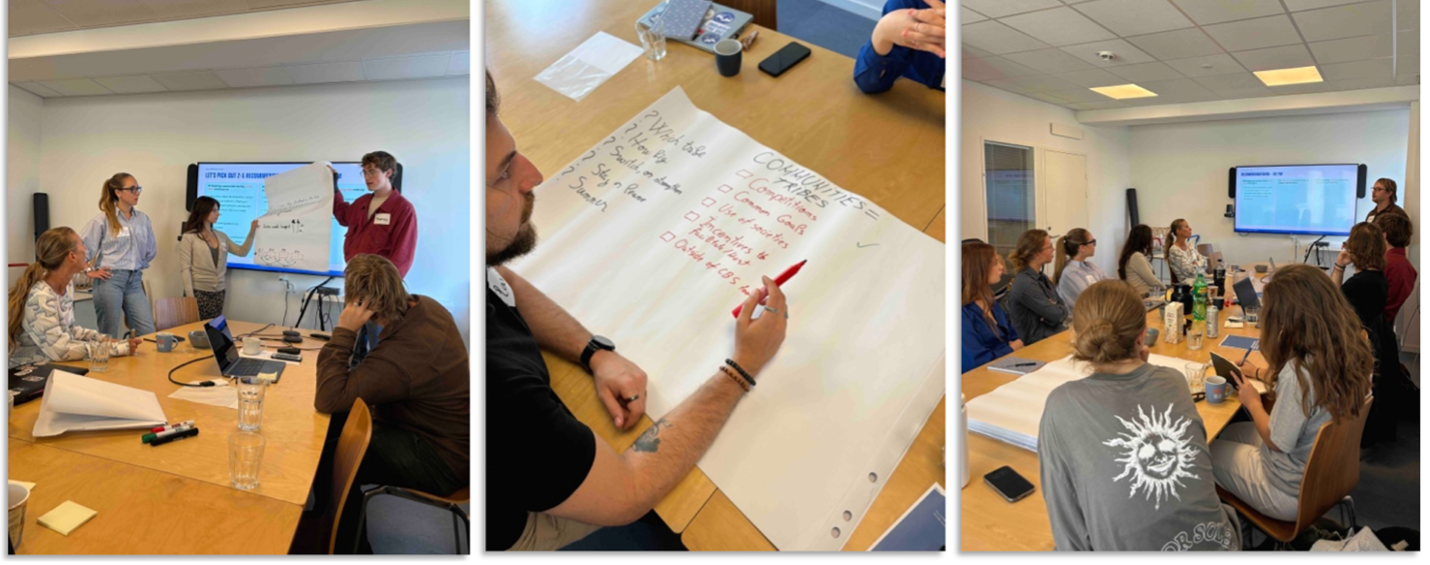
To further mature the recommendations from the report, we recently teamed up with CBS Students and hosted a workshop with 9 international students, where the recommendations were discussed and further elaborated.
Starting, struggling, and standing together: insights from the study
Students highlighted several positive aspects of CBS, including its English-first environment, career services and campus facilities. Experiences nevertheless differed considerably between study programs, particularly in the extent to which opportunities for social interaction were built into classes, group work and program activities.
Across the interviews, social connection emerged as a particularly important condition for well-being. Relationships gave students access to practical knowledge, support and a sense that they were not navigating an unfamiliar environment alone. Yet connections were often difficult to establish. Students described difficulties entering established social circles, while language could create informal divisions even where teaching takes place in English. The interviews also showed that proximity alone does not produce connection: how students are brought together, for example through study groups, matters.
Anchors and bridges: insights from the workshop
The workshop both strengthened and nuanced the report’s preliminary recommendations. The discussion complicated a seemingly straightforward ambition to strengthen “integration”. Several participants questioned whether successful international student well-being should be measured by how successfully international students form relationships “across the divide” with Danish students.
This led to an important distinction. Being with other international students can itself provide something valuable: other students understand what it is like to arrive from elsewhere, navigate unfamiliar systems and build a life in a new country. These students tend to form communities around shared languages, nationalities and experiences. At the same time, participants also wanted opportunities to meet Danish students and to cross the linguistic and social divisions they encountered at CBS. A useful way of understanding the discussion is that students may need both anchors and bridges: communities in which they can establish familiarity, support and belonging, alongside opportunities to encounter people outside those communities.
The workshop highlighted that CBS already offers many opportunities for social connection through introduction activities, study groups, student societies, buddy programs and events. There was also a strong consensus that study start could be used even more deliberately as a period for building initial anchors and wider bridges. There are good examples within CBS of practices that students experience as effective, which creates an opportunity to identify and share what works across programs instead of having every program invent its own approach.
Well-being beyond study start was another major topic, with participants pointing to the sharp drop in structured opportunities for connection after intro week and highlighted the summer break as especially strenuous for students who remain in Copenhagen.
Study groups emerged as the most divisive and complex topic regarding what they are intended to achieve and how they are facilitated. The workshop supported the value of pre-assigned groups, particularly in the early phases of a program where they can provide an immediate point of contact and create encounters across existing networks. At the same time, workshop participants stressed that a pre-assigned group is not automatically inclusive. Composition matters, language matters, and groups need support in establishing ways of working together. Existing dialogue-based tools developed by CBS Well-being Lab could be used to support these conversations within study groups.
Finally, we discussed how everyday practices shape participation. The report showed how informal shifts into Danish can leave international students outside conversations. One workshop participant described a simple practice from intro week: anyone switching away from English had to wear a deliberately silly hat until somebody else did the same. A playful intervention made the shared language norm visible. Other examples included rotating groups, structured classroom interaction and buddy arrangements involving more than two people, and there was a clear support for broader awareness of the vulnerable context of international students.
We carry these recommendations into the further work we undertake together with CBS Students in the coming years.